
calming face mask
Face mask for stressed skin
Soothes, hydrates, and relieves tired complexions
Soothes, hydrates, and relieves tired complexions
$124.00
-
2.5 fl oz (75 mL)

age better face mask
Face mask for firming
Instantly lifts and boosts radiance for fatigued skin
Instantly lifts and boosts radiance for fatigued skin
$168.00
-
2.5 fl oz (75 mL)
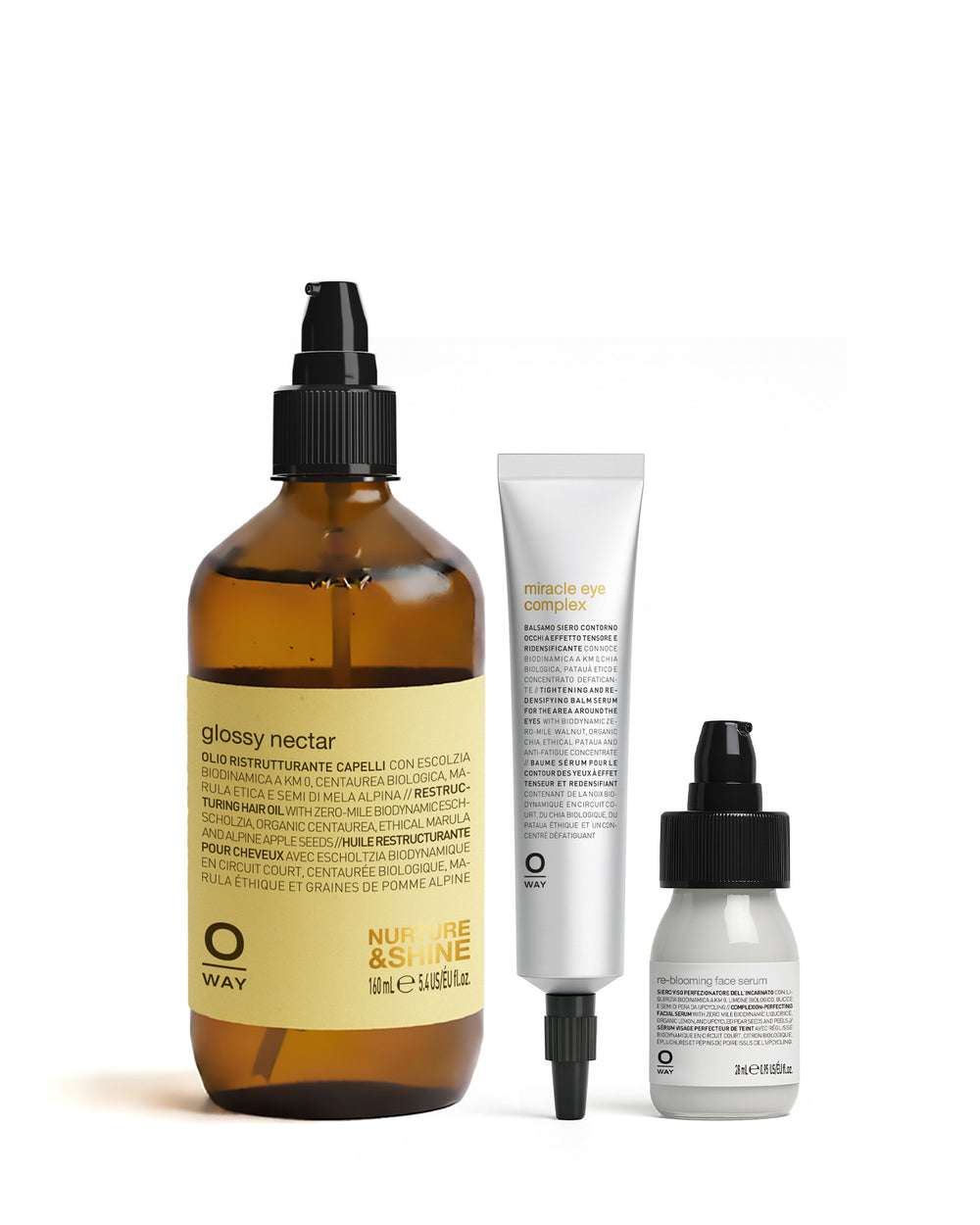
anti-aging luxury system
Complete pro-age treatment for hair, eyes, and face
Hair Oil ✽ Eye Complex ✽ Face Serum
Hair Oil ✽ Eye Complex ✽ Face Serum
$494.00
Sold Out • Join Waitlist

radiance face balm kit
Skincare kit for anti-aging
Three-step system to plump, regenerate, and renew
Three-step system to plump, regenerate, and renew
$586.00
-
50 ml + 5 ml + 5 ml
FAQ
What makes Oway face masks different from other natural skincare?
Most natural masks choose between comfort and efficacy — a soothing mask that does little, or an active treatment that sensitises. Oway's two face masks work differently because their botanical actives are sourced and cultivated with the same rigour as a clinical ingredient. The biodynamic milk thistle in the Age Better Face Mask is grown at Oway's own farm in Bologna, the Ortofficina, under biodynamic principles — no synthetic inputs, lunar-cycle cultivation, closed-loop regenerative agriculture — which produces plant extracts with measurably higher phytoactive concentration than conventionally sourced equivalents. The upcycled grape skin that delivers the mask's antioxidant depth comes from the wine production chain, meaning nothing is grown for the purpose of being discarded. The Calming Face Mask pairs two botanical traditions — balloon vine from Ayurvedic medicine and European mallow — with blackcurrant seed oil and Andean chia in a formula that actively repairs the skin barrier as it soothes. Both masks are produced with renewable energy, packaged in aluminium, and free from synthetic preservatives of concern. Vegan and cruelty-free throughout.
What are the two mechanisms at work in the Calming Face Mask, and how do they complement each other?
The formula works through two simultaneous processes that address the two root causes of sensitive and reactive skin. The first is botanical calming: balloon vine, mallow, and rosemary work at the surface and within the skin to interrupt the inflammatory signals that produce redness, tingling, and discomfort. These are not passive emollients — balloon vine in particular has a long tradition in Ayurvedic and European herbal medicine for its specific action on skin inflammation and has been studied for its calming properties in sensitive skin conditions. The second is barrier reinforcement: blackcurrant seed oil, Andean chia, and sunflower plant sterols replenish the lipid architecture of the skin — the moisture-retaining, protective layer that becomes depleted in reactive and stressed skin, making it progressively more vulnerable to further irritation. Addressing only the surface redness without repairing the barrier produces temporary relief; addressing only the barrier without calming active inflammation leaves the skin uncomfortable during treatment. The Calming Face Mask does both in a single step. The mineral clays — kaolin and volcanic bentonite — contribute gentle purification without the drying effect typically associated with clay masks, because the surrounding oils hold moisture at the surface.
What is balloon vine, and why is it the defining botanical in the Calming Face Mask?
Balloon vine (Cardiospermum halicacabum) is a climbing plant native to tropical regions of Asia, Africa, and the Americas, recognised in Ayurvedic medicine for centuries as a remedy for skin conditions involving inflammation, irritation, and discomfort. The common name comes from the plant's papery, balloon-shaped seed pods, though it is the leaf, flower, and vine extract used in skincare. In European regulatory circles, balloon vine has attracted serious scientific attention for its effects on sensitive skin — it is approved for use in natural cosmetics as an alternative to low-dose cortisone in sensitive skin formulations, which gives a sense of its calibre as a calming botanical. In the Calming Face Mask, it works alongside mallow — a European medicinal plant with its own long tradition of skin soothing and softening — to address both redness and discomfort simultaneously. The two plants approach skin calming from different directions, which is why they appear together rather than as a single active botanical.
What gives the Age Better Face Mask its lifting and firming effect?
The lifting sensation comes from two converging actions in the formula. The first is physical: volcanic bentonite clay, as it dries on the skin, creates a tightening film that temporarily tones and firms facial contours — this is the immediate sensory effect experienced during the application. The second is botanical: hibiscus flower and baobab fruit work at a deeper level to support elasticity and the density of the skin. Hibiscus, sometimes called the "botox plant" in natural skincare circles, contains a range of organic acids and mucilages that help firm and visibly plump skin over time; baobab — the fruit of one of Africa's most ancient trees — is rich in antioxidant compounds and skin-toning polysaccharides. Upcycled grape skin brings the mask's most potent elasticity support: the polyphenols and resveratrol locked into grape skin are among the best-studied botanical compounds for protecting skin from oxidative ageing and supporting its structural resilience. Organic Spanish broom contributes additional firming at the surface. The light-reflecting minerals in the formula then amplify the visual result, so that immediately after rinsing the skin appears both lifted and luminous.
What is biodynamic milk thistle, and what does it contribute to the Age Better Face Mask?
Milk thistle (Silybum marianum) is a flowering plant of the daisy family with a deep history in European herbal medicine, most widely known for its hepatoprotective properties — its role in protecting and supporting liver function — but increasingly studied in dermatology for its potent cellular antioxidant activity. Its active complex, concentrated in the plant's seeds, is one of the most powerful free-radical neutralisers found in the botanical world. In the context of an anti-ageing mask, this matters because oxidative damage — caused by UV exposure, pollution, and metabolic stress — is one of the primary drivers of structural skin ageing, breaking down collagen and elastin and accelerating the loss of firmness and radiance. The milk thistle in the Age Better Face Mask is grown biodynamically at Oway's Ortofficina farm, which means its phytoactive concentration is higher than commodity sourced equivalents and its cultivation is verifiable from farm to formula. It works in the mask alongside grape skin polyphenols and tocopherol (vitamin E from natural sources) to create a layered antioxidant shield at the cellular level while the clay and lifting botanicals work at the surface.
How do I choose between the Calming Face Mask and the Age Better Face Mask?
The two masks address different root concerns, and the choice follows from that. If the primary issue is reactive, sensitive, irritated, or compromised skin — redness that doesn't settle, a skin that responds to changing weather, products, or stress with discomfort — the Calming Face Mask is the right starting point. Its job is to calm what is inflamed and repair what is depleted. If the primary concern is the visible signs of time — loss of firmness, diminished radiance, skin that has started to lose its density and lift — the Age Better Face Mask works at that level. Skin can be both sensitive and ageing, of course, and those concerns are addressed separately in this question. For general guidance: younger skin experiencing environmental stress, hormonal reactivity, or sensitivity should reach for the Calming Mask; skin in the 40s and beyond seeking anti-ageing correction alongside weekly nourishment should reach for the Age Better Mask. Neither is exclusively for a single decade.
Who is the Calming Face Mask for, beyond obviously sensitive skin?
The Calming Face Mask is useful in a wider range of situations than the "sensitive skin" label implies. It is particularly well-suited for any skin that has been over-processed — by exfoliation, actives, professional treatments, or simply by using too many products — and needs time in a restorative state. Skin after a laser or chemical peel, after a reaction to a new product, or after a period of stress-related inflammation (which can manifest in skin of any type, not just skin classified as sensitive) responds well to the barrier-repair and calming function of the formula. It is also the appropriate choice for oily or combination skin that is experiencing concurrent sensitivity — the kaolin and bentonite provide gentle purification without contributing to dryness, while the anti-inflammatory botanicals address the reactive layer beneath. During the colder months, when barrier function typically declines and skin becomes more reactive even in those who don't consider themselves sensitive, the Calming Face Mask functions as a preventative maintenance treatment regardless of skin type.
Can either mask be used on oily or combination skin?
Both can be used on oily and combination skin, with different emphases. The Calming Face Mask contains both kaolin and volcanic bentonite, which draw excess oil and impurities from the pores during the contact time — making it functionally useful for oily skin even though its primary purpose is calming. The combination of purification and anti-inflammatory action makes it particularly useful for oily or combination skin prone to reactivity: skin that produces excess oil and simultaneously shows redness or sensitivity is well served by a mask that addresses both in one step. The Age Better Face Mask also contains bentonite for oil absorption, which means it too suits combination and oily skin without leaving a heavy, occlusive finish. The rich plant oils in its base might seem counterintuitive for oily skin, but the formula's structure allows those oils to deliver their active payload — grape skin antioxidants, hibiscus firming compounds — without remaining on the surface as excess lipid. Both masks are suitable; the Calming Mask is the first choice for oily skin with reactivity, the Age Better Mask for oily or combination skin primarily concerned with firming and anti-ageing.
How do these masks relate to the exfoliating treatments — should I use them before or after?
Masks and exfoliators serve different stages of the skin ritual and work best in a deliberate sequence. Exfoliation — whether through the Resurfacing Face Peel's fruit enzymes or the Glowing Face Gommage's clay polish — prepares the skin by removing the layer of dead cells that would otherwise sit between the mask's botanicals and the living skin beneath. The Age Better Face Mask specifically recommends application after exfoliating, because freshly refined skin absorbs the grape skin polyphenols, hibiscus, and milk thistle at greater depth. The Calming Face Mask, by contrast, is not typically used directly after an exfoliating step — exfoliation on already-reactive skin can worsen sensitivity rather than prepare it. For sensitised skin, the correct sequence is: gentle non-exfoliating cleanser → Calming Face Mask. For normal to combination skin seeking anti-ageing correction: exfoliating step → Age Better Face Mask. Do not use any exfoliator and the Resurfacing Face Peel on the same evening as either mask; one or the other per session is the appropriate protocol.
Which mask suits skin that is both sensitive and showing early signs of ageing?
This is a genuinely common combination — skin that has become more reactive with age, often after the hormonal changes of the late 30s and 40s, while simultaneously showing early loss of firmness or radiance. Neither mask alone is the complete answer, but the Calming Face Mask takes precedence as long as the skin is in an active sensitive phase. Attempting anti-ageing correction on a compromised barrier is counterproductive — the skin cannot benefit from lifting and firming actives when it is too reactive to tolerate them, and many anti-ageing ingredients, including the organic acids and botanical complexes in the Age Better Mask, can intensify discomfort on sensitised skin. The sequence that tends to work well is: use the Calming Face Mask consistently for four to six weeks to restore barrier integrity and reduce baseline reactivity, then introduce the Age Better Face Mask once a week alongside the Calming Mask. Once the skin's reactivity has settled, the two masks can alternate in a weekly rhythm — Calming Mask one week, Age Better Mask the next, or one of each per week depending on how the skin feels.
Where do face masks fit in a full skincare routine?
Masks belong in the treatment layer of a routine — after cleansing and before any serum or moisturizer. The full sequence on a mask evening is: cleanser → exfoliator (Age Better Mask evenings only, if exfoliation is planned) → mask → De-Stress Tonic Potion → serum → moisturizer. The mask replaces the exfoliating step if no exfoliation is used that evening; it does not add another layer on top of the routine but takes up the treatment slot before the rest of the routine continues. Rinse masks thoroughly before applying the tonic or serum — residue left on the skin can interfere with the absorption of subsequent treatments. Both masks are formulated for evening use, when the skin's natural renewal cycle is most active. SPF the following morning is a consistent companion to any treatment-heavy routine. On non-mask evenings, the cleanse-tonic-serum-moisturizer sequence continues as normal; the mask is a weekly addition to that rhythm, not a replacement for daily care.
Not sure where to start?
Let us curate a ritual tailored just for you. Answer a few quick questions and discover a selection designed around your unique needs, habits, and preferences.